26 Lavender Spring Nails That Feel Fresh, Soft, and Totally Wearable in 2026

Trends come and go, but lavender keeps earning its place at the top of every spring nail list. It sits in a rare sweet spot feminine without being fussy, soft without feeling forgettable. Whether you want something minimal enough for the office or bold enough to anchor a full spring look, lavender delivers real range.
This list covers 26 distinct lavender spring nails ideas across finishes, lengths, and skill levels. Each one is visually distinct, genuinely wearable, and worth saving. No filler, no repeats just ideas that actually translate from screen to hand.
Why Lavender Is Specifically a Spring Nail Color (And Not Just Any Season)
Lavender’s seasonal dominance isn’t random. The color sits in the 380–450nm wavelength range, the same band the eye associates with early morning light, flowering fields, and the low-contrast softness of spring before full bloom sets in. That perceptual connection is why lavender feels spring-appropriate in a way that, say, a warm coral or a rich burgundy doesn’t.
There’s also a practical timing element. Lavender is light enough to pair with the bare-skin palette of early spring when people aren’t yet reaching for the saturated bright of summer but it has enough pigment to feel intentional, unlike the nude and barely-there shades that carry most of the winter-to-spring transition.
The shade also photographs well in the soft, diffused light typical of spring overcast skies, golden-hour warmth, natural window light. That matters for a nail trend that lives largely on social media, where a color that photographs flat gets abandoned quickly regardless of how it looks in person.
What makes 2026 different: the lavender conversation has shifted from pure pastels toward more complex tones grey-leaning, smoky, and dusty variations that carry better across seasons. The lavender that trends in spring 2026 isn’t the saccharine lilac of earlier years. It’s more editorial, more considered, and that’s exactly why it’s earned a permanent place in the seasonal rotation rather than a one-year moment.
How to Choose Your Lavender Shade Based on Skin Tone
The question isn’t whether lavender works on your skin tone, it does. The question is which lavender. The undertone of the shade matters more than the depth or saturation.
Fair skin with cool undertones (pink/blue base): Almost any lavender works here. Lean into the cooler, bluer end of the spectrum , true lavender and periwinkle-adjacent shades create a monochromatic harmony with the skin’s natural pink-blue undertone. Avoid warm, pink-heavy lavenders, which can wash out fair cool skin rather than complement it.
Fair skin with warm undertones (peach/yellow base): Choose lavenders with a slight pink or warm flush rather than cool, grey-leaning shades. A dusty rose-lavender or a soft lilac with visible pink will feel harmonious. Pure grey-lavender can make warm fair skin look sallow.
Medium skin with neutral or olive undertones: This is the most forgiving range for lavender. Both cool and warm variations work, the medium-depth contrast keeps any shade from disappearing. Chrome and iridescent lavenders are especially striking here because the mid-range skin tone lets the metallic shift read clearly without competing.
Medium-deep to deep skin with warm undertones: Reach for deeper, more saturated lavenders rather than pastels, which tend to grey out against richer skin. A medium lavender not too light, not muted reads with real presence. Holographic and duochrome formulas tend to perform particularly well on deeper skin because the contrast enhances the light-shift effect.
Deep skin with cool undertones: Bold, vivid lavenders and deep purple-lavenders work exceptionally well. A dusty pale lavender will be barely visible; opt for something with clear pigment saturation. Chrome lavender is one of the most striking options on deep cool skin.
Quick shortcut: hold a lavender swatch near your inner wrist. If it makes your veins look more blue-purple, the shade is working with your undertone. If it turns them greenish or greyish, go warmer or deeper.
Soft & Understated: When Less Does More

These shades work best when your goal is a put-together look that doesn’t demand attention but still earns compliments.
1. Sheer Lavender Jelly Nails
A translucent lavender base that lets your natural nail show through slightly. The effect is glass-like and clean perfect for shorter nails that benefit from the illusion of depth.
See More About : 38 Spring Break Nails That Are Fresh, Fun, and Actually Wearable in 2026
2. Milky Lavender with a Glossy Top Coat
Soft white base tinted with the faintest lavender. The glossy finish pushes it from understated to polished without adding any visual noise.
3. Matte Lavender Solid
Same shade, completely flat finish. Matte lavender reads more editorial and modern than glossy great for square or coffin shapes where the matte finish catches light differently on each nail.
4. Lavender French Tips on Natural Nails
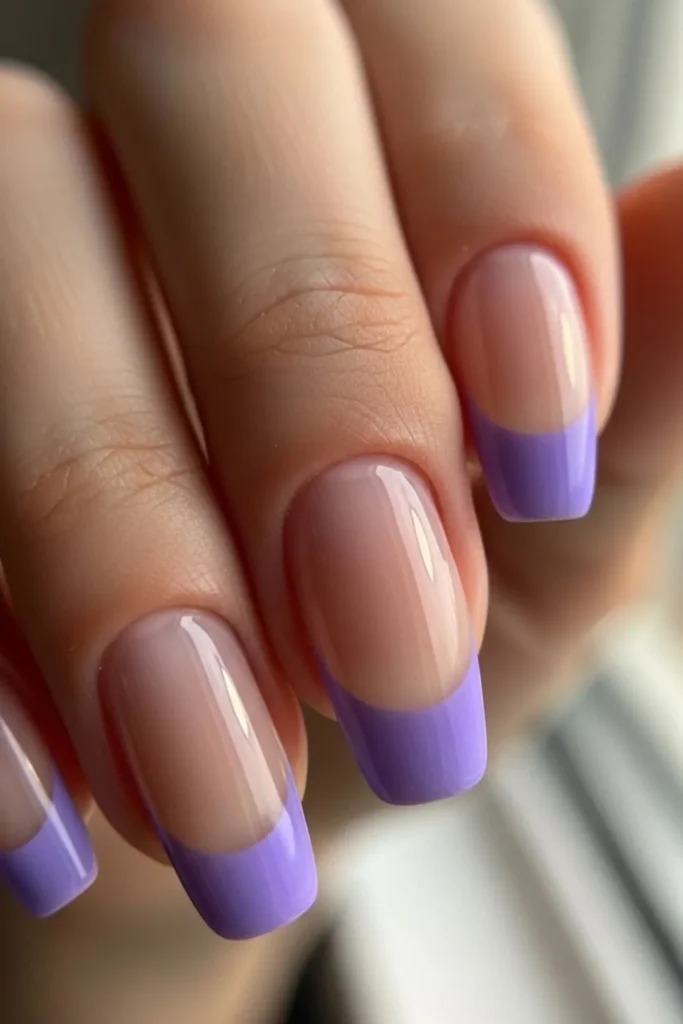
A classic French tip swap: replace white with soft lavender. Works beautifully on both short and medium lengths. Subtle enough for professional settings, fresh enough to feel Lavender Spring Nails-appropriate.
5. Dusty Lavender (Grey-Toned)
This leans more ash than purple, which makes it one of the most versatile lavender shades available. It flatters both warm and cool skin tones and has the best grow-out of any shade on this list, the grey undertone means the line between polish and natural nail stays soft rather than obvious.
6. Pale Lavender Ombre on Short Nails
A fade from bare or nude at the base to soft lavender at the tip. On short nails, the gradient is compressed and reads as a tonal blush of color rather than a dramatic ombre.
Works best when: you want easy, low-maintenance nails that still feel intentional.
Common mistake: going too light on short nails, the color disappears. Use at least two coats of a visible lavender, even with sheer formulas, and apply the deepest concentration right at the tip rather than blending it all the way back to the cuticle.
Texture & Finish Play: Adding Dimension Without Complexity

7. Lavender Chrome Nails
High-shine metallic lavender that shifts in light. Striking on almond or oval shapes. This is a one-color look that photographs exceptionally well.
8. Lavender Velvet (Cat Eye Effect)
A magnetic gel polish that creates a soft brushed-velvet texture across the surface. The effect changes depending on the angle moody and rich, not typical pastel territory.
9. Lavender Holo Glitter
Holographic micro-glitter suspended in a lavender base. In direct sunlight, it fractures into a full spectrum. More wearable than chunky glitter because the texture stays smooth.
10. Frosted Lavender

A dusty, almost chalky lavender with a satin-to-matte finish. Think of it as the 2026 update to the classic pearl nail, same softness, but without the sheen that dates the look. It photographs especially well in natural light and pairs cleanly with gold jewelry.
11. Lavender Sugar Nails
A granular, sparkle-dusted finish achieved with sugar-effect powder. The texture catches light subtly and adds tactile interest without visual chaos.
See More About : 48 Best Nail Shapes For Short Fingers That Actually Flatter Your Hands
12. Iridescent Lavender Shift
A duochrome formula that shifts from lavender to soft pink or silver depending on the angle. Works especially well on coffin and stiletto shapes where the curve enhances the color shift.
Who this is best for: people who want a one-color look that still feels like an event. Who should skip this: anyone whose hands are frequently wet, gloved, or exposed to cleaning products, duochrome and texture finishes lose their shift and develop micro-chips faster than solid formulas under those conditions.
Nail Art Ideas: Lavender as the Star or the Base

13. Lavender Floral Accent Nail
Four Lavender Spring Nails in solid polish, one accent nail featuring hand-painted or stamped small florals in white and deeper purple. Lavender Spring Nails without being predictable.
14. White Daisies on Lavender
Bold white daisy outlines on a solid lavender background. The contrast is graphic and clean highly pinnable, easy to recreate with a dotting tool and fine brush.
15. Lavender Spring Nails and Sage Abstract Lines
Thin, freehand lines in sage green crossing over a lavender base. Minimal but artistic. The color pairing is fresh and modern without being trendy in an expiration-date way.
16. Lavender Spring Nails Marble

White or cream base with lavender veining created using a thin brush or water-marbling technique. Each nail looks slightly different, which adds an organic, high-end feel.
17. Butterfly Wing Accent
One or two nails feature a delicate butterfly wing in lavender and pale gold. The remaining nails stay solid lavender or nude. The butterfly motif has maintained strong search interest through 2025–2026 because it reads as seasonal without being juvenile, the key is keeping the wings small and the palette restrained.
18. Lavender Spring Nails Cloud
Soft puffs of white layered over a lavender sky background. Dreamy and rounded best suited for oval or round nail shapes where the curves echo the softness of the design.
See More About : 21 April Spring Nail Ideas That Are Fresh, Floral, and Actually Wearable in 2026
19. Purple Ombre with Lavender Mid-Tone
A gradient that moves from deep violet at the base to soft lavender at the tip. Dramatic but still Lavender Spring Nails-appropriate because of the pastel tip finish.
20. Lavender Spring Nails and Gold Foil
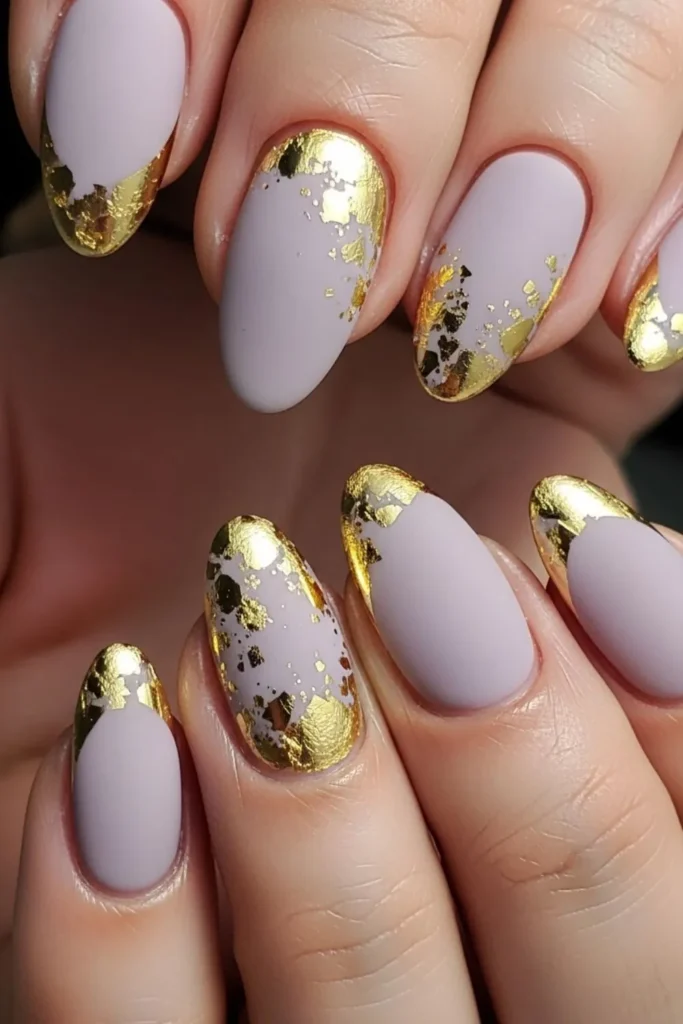
Crinkled gold foil applied over a matte lavender base. The contrast between the flat lavender and the reflective foil creates a luxe, editorial effect.
21. Negative Space Lavender
Part of the nail left bare (natural or clear), with lavender only at the tip or sides. The bare section creates visual breathing room that makes the color feel intentional rather than incomplete.
Works best when: you have steady hands or access to nail art tools. Most of these designs can be simplified with nail stickers or stamping plates. Common mistake: overloading accent nails. One or two decorated nails always read better than five competing designs.
Which Lavender Nail Styles You Can Actually DIY (And Which Ones Need a Salon)
Not every look on this list requires a nail technician. But some genuinely do, and it’s worth being honest about which is which before you spend money on supplies you won’t use.
Genuinely DIY-friendly (beginner to intermediate):
Sheer jelly, milky lavender, matte solid, and dusty lavender are all single-coat-to-two-coat applications that require nothing more than prep, patience, and a good top coat. These are realistic at-home options for most people. Lavender French tips are achievable with French tip guides or striping tape, the technique takes one practice run to get consistent. Pale lavender ombre on short nails works well with a makeup sponge; apply the lavender shade on the sponge and dab at the tip rather than trying to brush-blend, which almost never works cleanly.
Lavender and gold foil, lavender chrome (with a chrome powder kit), and white daisy designs on lavender are all achievable at home with the right supplies. Chrome powder kits for home use have become significantly more accessible since 2024, a silicone finger applicator and a gel base are the only equipment requirements. Daisies can be recreated with a dotting tool for the center and a thin detail brush for the petals; the design reads well even when not perfectly symmetrical.
Realistic with practice, but expect a learning curve:
Butterfly wing accents, marble veining, and freehand sage abstract lines require a steady hand and a thin nail art brush. The marble effect specifically benefits from reference imagery as you work, streaming the result as it dries is the most common mistake (wet polish moves). Give yourself two practice runs on a silicone mat before touching your actual nails.
Salon-recommended:
Velvet cat-eye effect nails require a specific magnetic gel polish and UV lamp, the magnet has to be applied within a narrow window during curing, which is difficult to time accurately without experience. Iridescent duochrome shifts and holographic glitter formulas can be done at home, but the application consistency that makes them look intentional rather than clumpy typically requires a technician. If you want the full effect rather than an approximation, these are worth the salon visit.
Budget note: most DIY-friendly designs on this list require a base coat, two to three lavender polishes in different tones, a glossy and matte top coat, and a thin detail brush. That’s a one-time outlay of roughly $30–50 that covers every beginner-to-intermediate design here.
Seasonal Pairings: Lavender Combinations That Feel Like Lavender Spring Nails

22. Lavender and Peach
Alternate lavender and soft peach nails. Warm and cool tones balanced this pairing photographs warmly and feels distinctly Lavender Spring Nails without leaning too sweet.
23. Lavender Spring Nails and Mint
Two cool pastels that work because they share the same tone weight. Neither dominates, and together they read fresh and clean.
24. Lavender and Nude
A practical combination for everyday wear. Lavender on the ring finger and pinky, nude on the rest or reverse it. Wearable for work environments that don’t allow bold color on all nails.
25. Lavender Spring Nails and White

The cleanest combination on this list. Two-tone French, alternating nails, or white floral art on lavender any of these variations work with minimal skill and maximum polish.
26. Lavender and Lilac Mix
Two slightly different shades of purple-pink applied to different nails. The tonal variation creates depth without the contrast feeling jarring. Works best when one shade is clearly lighter.
Who this is best for: anyone who wants Lavender Spring Nails energy without committing to a full lavender set. Who should skip this: if you prefer cohesive, one-color looks mixing shades can feel incomplete if not done with intention.
Lavender Nail Polish Shades Worth Actually Buying in 2026
The difference between a lavender that photographs the way you expect and one that dries grey or faded usually comes down to the formula. These are the shades consistently delivering across the styles in this article.
For sheer and jelly finishes: OPI’s “Do You Lilac It?” remains a reliable sheer lavender that layers well without muddying. Essie’s “Minimalistic Masterpiece” from the 2025 Gel Couture line leans slightly more translucent and works especially well over a nude base. For a true jelly effect with depth, ILNP’s “Ultraviolet” (a lavender jelly packed with micro-shimmer) is a consistent community recommendation.
For matte and dusty lavender: Sally Hansen’s “Miracle Gel in Misty Lilac” dries with a natural satin-matte finish that doesn’t require a separate matte top coat, practical for everyday use. For a more editorial, true-grey dusty lavender, Zoya’s “Seraphina” hits the ash-lavender tone that works across the widest range of skin tones.
For chrome and holographic effects: Born Pretty’s lavender chrome powder applied over a no-wipe gel top coat produces a mirror-finish comparable to salon results. For holographic lavender, ILNP’s “Princess Cut” gives clean rainbow fracture in direct sunlight without the gummy texture some holo formulas produce.
For gel at home: Beetles Gel Polish in “Wisteria” has strong reviews for true lavender color payoff without the purple drift that some lavender gels show after curing. Always cure under a 48W UV/LED lamp for at least 60 seconds, undercuring is the most common reason lavender gels cure darker or more muted than expected.
For nail art and accent work: Modelones’ thin-brush nail art polish in white is the practical choice for daisy designs and abstract lines on lavender, the fine brush is included and the formula stays workable for long enough to correct mistakes.
See More About : 46 Spring Aura Nails That Look Like You Bottled the Season (2026 Trend Guide)
Frequently Asked Questions
Is lavender a good nail color for all skin tones?
Yes, but the undertone matters. Cooler, ash-toned lavenders suit fair and cool skin tones best. Warmer, slightly pink-leaning lavenders complement medium and deeper skin tones more naturally.
How long does Lavender Spring Nails polish last without chipping?
Gel formulas typically last 2–3 weeks with proper prep and a quality top coat. Regular polish lasts 5–7 days for most people, particularly with lighter formulas that need thinner coats. If longevity is the priority, BIAB (Builder In A Bottle) overlays have become a widely-available salon option in 2026 that extends wear to 4+ weeks while keeping nails flexible enough to avoid lifting.
Can Lavender Spring Nails work for formal or professional settings?
Solid lavender, dusty lavender, or a lavender French tip reads professional in most settings. Heavily embellished or dark-toned lavender designs are better suited for social occasions.
What nail shape looks best with lavender?
Lavender reads differently depending on nail shape, and the variation is more pronounced than with most colors. Almond and oval shapes enhance the softness of the color, the tapered tip echoes the delicate quality of lavender without making it look weak. Square and coffin shapes work better with bolder or more editorial lavenders (matte, chrome, or deep-toned) because the geometric edge adds contrast that stops the color from feeling too soft. Short round nails pair best with sheer or milky lavender formulas; a deep or chrome lavender on a very short round nail can look disproportionate. Stiletto shapes work with any lavender but are best served by the iridescent or duochrome options where the curved surface enhances the color shift.
Can you wear lavender nails if you prefer a minimal, clean aesthetic?
Yes, and lavender may actually be better suited to a clean aesthetic than most spring colors. A single-coat sheer lavender jelly, a bare-nails milky lavender, or a matte dusty lavender in a square short shape reads minimal without being plain. The key is keeping the finish flat (matte or satin rather than glossy) and skipping any art or accent nails. Two coats of a grey-toned lavender in a matte finish is genuinely one of the cleaner nail looks available for spring 2026.
Does lavender nail polish stain nails?
Standard lavender polishes in the mid-tone range rarely stain, but bright or deeply pigmented purple-lavenders can. The risk is the same as with any strongly pigmented formula: without a base coat, the pigment penetrates the nail plate over time. A quality ridge-filling base coat eliminates most staining risk. If you already have staining from a previous dark polish, a buffing block followed by a whitening base coat will minimize the effect before applying lavender on top.
How do I stop lavender nail polish from looking faded or washed out?
The most common reason lavender looks washed out after drying is applying too thin a coat on the first pass. Lavender pigment is light enough that a single thin coat reads almost transparent, which makes most people apply a second coat before the first has set leading to uneven coverage. The fix: apply a first coat and let it dry for at least two minutes before adding the second. If using a sheer formula intentionally, layer it over a white or very pale nude base to push the lavender higher without adding a third coat of color. Finish with a high-gloss top coat, which amplifies perceived pigment saturation by roughly 20–30% compared to the dry-down color.
What’s the best way to remove lavender gel nails without damaging them?
Soak cotton pads in 100% acetone (not standard nail polish remover), press them directly against each nail, and wrap the fingertips in small pieces of foil to hold them in place. Wait 12–15 minutes not 8, which is the most commonly given time and is generally too short for a full gel cure. Slide the cotton pad off with slight side-to-side pressure rather than pulling upward; if the gel doesn’t release cleanly, rewrap and wait another 3–5 minutes. Attempting to peel or force gel that hasn’t fully loosened is the primary cause of surface damage to the nail plate. Finish with a cuticle oil application to the nail bed and surrounding skin, which rehydrates what acetone removes.
What nail shape looks best with lavender?
Lavender reads differently depending on nail shape, and the variation is more pronounced than with most colors. Almond and oval shapes enhance the softness of the color, the tapered tip echoes the delicate quality of lavender without making it look weak. Square and coffin shapes work better with bolder or more editorial lavenders (matte, chrome, or deep-toned) because the geometric edge adds contrast that stops the color from feeling too soft. Short round nails pair best with sheer or milky lavender formulas; a deep or chrome lavender on a very short round nail can look disproportionate. Stiletto shapes work with any lavender but are best served by the iridescent or duochrome options where the curved surface enhances the color shift.
Can you wear lavender nails if you prefer a minimal, clean aesthetic?
Yes, and lavender may actually be better suited to a clean aesthetic than most spring colors. A single-coat sheer lavender jelly, a bare-nails milky lavender, or a matte dusty lavender in a square short shape reads minimal without being plain. The key is keeping the finish flat (matte or satin rather than glossy) and skipping any art or accent nails. Two coats of a grey-toned lavender in a matte finish is genuinely one of the cleaner nail looks available for spring 2026.
Does lavender nail polish stain nails?
Standard lavender polishes in the mid-tone range rarely stain, but bright or deeply pigmented purple-lavenders can. The risk is the same as with any strongly pigmented formula: without a base coat, the pigment penetrates the nail plate over time. A quality ridge-filling base coat eliminates most staining risk. If you already have staining from a previous dark polish, a buffing block followed by a whitening base coat will minimize the effect before applying lavender on top.
What’s the best way to remove lavender gel nails without damaging them?
Soak cotton pads in 100% acetone (not standard nail polish remover), press them directly against each nail, and wrap the fingertips in small pieces of foil to hold them in place. Wait 12–15 minutes not 8, which is the most commonly given time and is generally too short for a full gel cure. Slide the cotton pad off with slight side-to-side pressure rather than pulling upward; if the gel doesn’t release cleanly, rewrap and wait another 3–5 minutes. Attempting to peel or force gel that hasn’t fully loosened is the primary cause of surface damage to the nail plate. Finish with a cuticle oil application to the nail bed and surrounding skin, which rehydrates what acetone removes.
Key Takeaways
- Dusty or grey-toned lavender is the most versatile shade and suits the widest range of skin tones and settings.
- Matte finishes make lavender look more modern and editorial than glossy formulas on the same shade.
- Accent nail designs work best when kept to one or two nails rather than spread across the full set.
- For the most cohesive look, lavender pairs best with white, nude, sage green, and soft peach combinations that share tonal weight without competing for attention.
- Gel formulas hold lavender pigment more accurately than regular polish, which can look faded after one coat.
Conclusion
Lavender Lavender Spring Nails work because the color is genuinely flexible it shifts in mood depending on finish, shape, and pairing. A matte dusty lavender reads nothing like a chrome lavender, and a sheer jelly version feels completely different from a marble design using the same base shade. That range is exactly what makes it worth exploring beyond the obvious choice.
Use this list as a reference, not a rule. Start with the finish or style that fits your daily routine, nail art you’ll actually wear beats a design that chips by Wednesday. The best lavender spring nails are the ones that still feel good three weeks in, not just on day one.